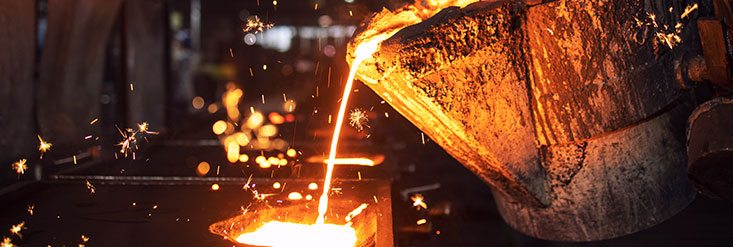
World Steel Association data for 2025 places Russia at 67.8 Mt of crude steel production, ranked fifth globally, while the Global Energy Monitor Russia steel briefing shows a capacity mix led by BF-BOF with EAF and DRI-EAF routes also present. For refractory buyers, that means the conversation quickly moves from a product list to converter, EAF, ladle, tundish, hot-metal ladle, torpedo ladle, reheating furnace, and continuous casting duties.
Steelmaking is the main demand line
Russian steel customers usually care about lining life, slag-line wear, hot-zone erosion, thermal shock, spalling risk, repair compatibility, and whether the selected material can protect the next maintenance window. Magnesia-carbon brick, alumina-magnesia-carbon brick, Al2O3-SiC-C brick, ladle castable, gunning mix, ramming mix, and dry material should be explained by equipment and working area rather than by a bare catalogue name.
This is why the Russia page should stay technical and buyer-facing. It should show how a material route fits a converter, ladle, electric furnace, hot-metal handling, or continuous-casting position; it should not only say that the product is high performance, customizable, and available for export.
Non-ferrous metallurgy adds a second demand line
The supplied strategy document identifies nickel, copper, aluminum, and other non-ferrous smelting routes as important secondary demand. These duties usually require stronger resistance to metal penetration, aggressive slag, alkali vapor, thermal cycling, and structural peeling. Magnesia-chrome, aluminum-chrome, magnesium-spinel, burned magnesia, and corrosion-resistant castable should therefore be presented through furnace type and wear mechanism.
When a buyer is considering replacement material or long-term replenishment, material equivalence, sample expectation, certificate scope, and batch traceability may become more important than the first unit price. These items should be prepared together with the recommended material route.
Cement, lime, and industrial kilns are a supporting line
CemNet reports pressure on Russian cement output in 2025 and cites a full-year estimate of 58.3 Mt, down 10.4 percent. That supports the strategy document’s recommendation: cement and lime should remain in the Russia page, but not as the main growth story. The useful angle is rotary kiln zoning, kiln hood and cooler maintenance, gunning repair, shutdown planning, and reducing kiln stoppage risk.
Before quotation, Russian customers should be invited to provide furnace type, working area, operating temperature, slag chemistry, current lining reference, installation method, expected campaign life, Russian or bilingual document needs, packing marks, moisture protection, destination route, and delivery window. Those details make the first quotation closer to a usable supply plan.